Home › Health › Energy & Fatigue
Energy & Fatigue
Tried Every Supplement for Your Energy — and Still Exhausted? Here's Why None of It Worked
If you lined up everything you've tried for your energy, it'd be a long, expensive row. And you're still dragging. That's not a you problem — it's a category problem.

Note: Every time a supplement didn't work, you probably wondered what was wrong with you. By the end of this, you'll see it was never you. It was the kind of fix you were handed.
Open the cabinet and there they are. The energy drinks. The B12 that "everyone" said would change your life. The multivitamin your sister swore by. The greens powder. The ashwagandha gummies you bought after a late-night scroll. Some half-empty, some barely touched. A long, expensive row of things that were each, at the time, going to be the answer.
And here you are, still dragging through the afternoon. Still hitting the wall. Still wondering why the thing that worked for the woman in the reviews did nothing for you.
So you've started to draw the obvious, quiet conclusion: maybe it's me. Maybe I'm just tired in a way that can't be fixed.
Here's what almost everything you tried had in common
Look back down that row of bottles and you'll notice something. Nearly all of them were doing the exact same job: forcing energy on top of a system that's already drained.
- Caffeine and energy drinks — a spike, then a crash, never any real energy
- B12 mega-doses — pushed harder on a body that's exhausted from being pushed
- A generic multivitamin — fine for gaps, but never aimed at why you're tired
- Under-dosed "stress" gummies — too little active ingredient to do anything real
None of them touched the actual reason you're running on empty. Which is why every one of them "worked" for about a week, then quietly stopped — and you moved on to the next bottle.
The three reasons nothing worked (none of them are "you")
When a stress or energy supplement genuinely fails someone, it's almost always one of three things — and once you see them, the whole shelf makes sense:
- Wrong category. Stimulants mask tiredness. They don't support the run-down system underneath it. You needed a different tool entirely — not a stronger version of the same one.
- Too low a dose. Many products use a pinch of cheap, low-grade extract so the label looks good. Clinical results come from standardized extracts at real doses — most bottles never get close.
- Not enough time. The fixes that actually work on the root cause build over weeks, not hours. If you quit at day five because you "felt nothing," you walked out before the part that works.

So if you've been blaming yourself, you can stop. You weren't doing it wrong. You were handed the wrong kind of fix — stimulants that spike and crash — when what your body needed was support for the stressed-out system actually wearing you down.
The different category: support the cause, not the symptom
For a lot of people — especially women carrying years of low-grade, never-ending stress — the real driver of exhaustion isn't a missing stimulant. It's a stress response that's stuck "on," quietly burning energy all day, so you wake up tired no matter how long you slept.1
The tool that fits that problem isn't another jolt. It's adaptogens — a class of plants, with rhodiola and ashwagandha the most studied, that help the body adapt to and recover from stress at the root rather than whipping it into a temporary high.
- Standardized rhodiola showed measurable anti-fatigue effects within about a week in stressed adults2
- Ashwagandha reduced cortisol by roughly 15–30% in chronically stressed adults3
- Unlike caffeine, adaptogens don't block your "tired" signal — so there's no tolerance build-up and no crash
- They work with your nervous system's own regulation, which is why they build over weeks rather than spiking and fading
What makes this different in practice
Habba's Rhodiola Energy Complex was built to fix all three failure points at once. It uses rhodiola and ashwagandha — the actual root-cause adaptogens — at clinically relevant doses, paired with calming support (magnesium glycinate, L-theanine, magnolia, passionflower) and the foundational nutrients (B6, D3, magnesium) real energy is built on.
It's taken as drops under the tongue, so it absorbs in seconds instead of waiting on slow digestion. And it asks for the one thing the others never earned from you: a real 30-day trial. The calm tends to land in the first few days; the steadier energy builds over weeks two to four as your stress response recalibrates.
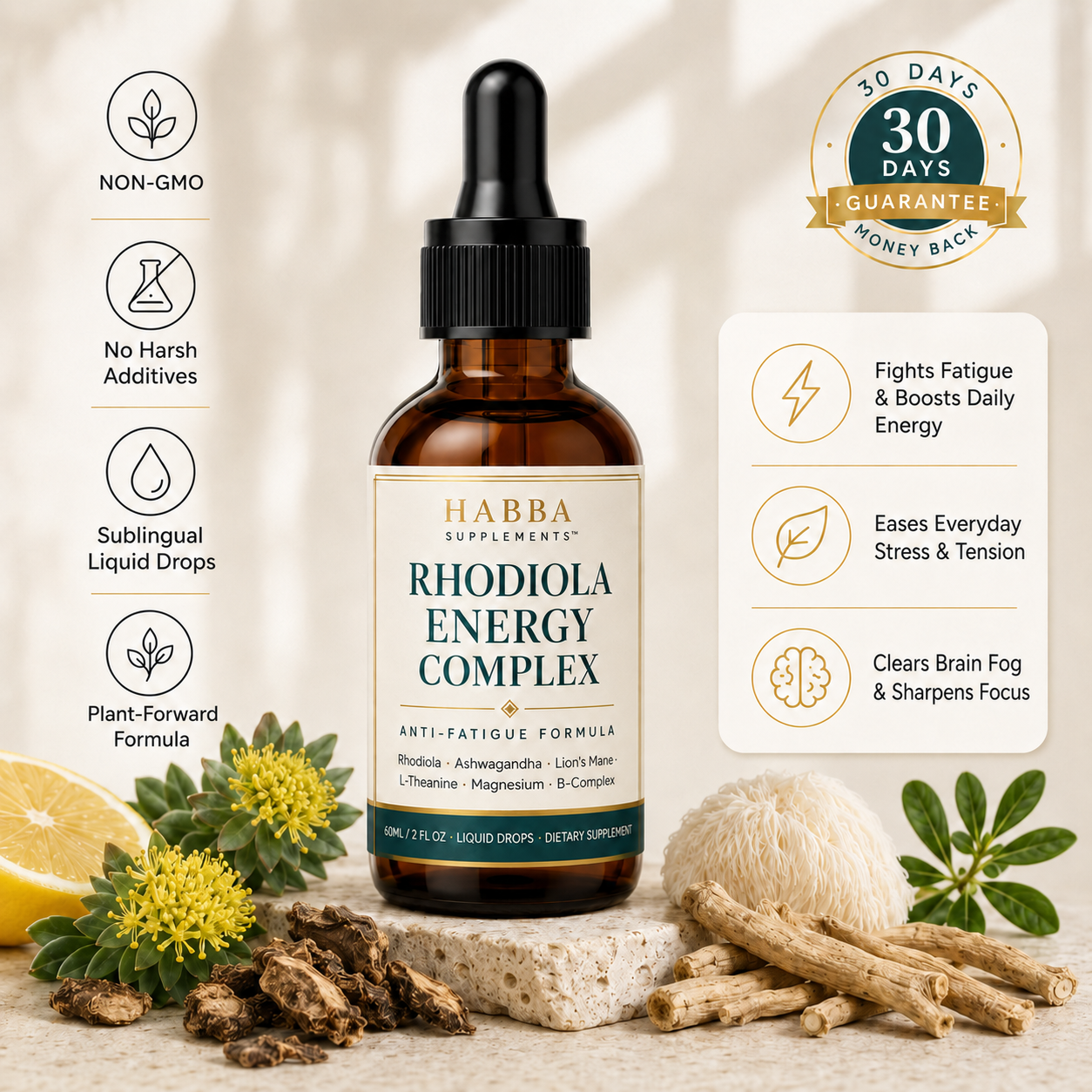
Habba™ Rhodiola Energy Complex
Not another stimulant. Adaptogens that support the stressed, run-down system at the root — calm, steady energy with no caffeine, no jitters, no crash.
Try a Different Approach →Habba vs. the row of bottles
| Habba | Stimulants & quick fixes | |
|---|---|---|
| Targets stress-driven fatigue at the root | ✓ | — |
| Calm, steady energy — no crash | ✓ | — |
| No caffeine, no jitters | ✓ | — |
| Adaptogens (rhodiola + ashwagandha) | ✓ | — |
| Clinically relevant doses | ✓ | — |
| Fast-absorbing sublingual drops | ✓ | — |
You didn't fail. The products did.
If you're going to try one more thing, you deserve to know why it's actually different — not just a new label on the same idea. This isn't a stronger stimulant. It's the other category entirely: support for the system that's been wearing you down the whole time. A different approach, built around the cause the others kept missing.
What readers who'd "tried everything" are saying
Hannah Reeve
Wellness Editor at the Habba Journal, writing about energy, stress, and the science of feeling like yourself again. Former owner of a very crowded supplement shelf.
References
- UCLA Health (2024). "Feeling tired but wired? Here's what might be causing it."
- Spasov, A.A. et al. (2000). "A double-blind, placebo-controlled study of a standardized extract of Rhodiola rosea SHR-5 on fatigue." Phytomedicine, 7(2), 85–89.
- Chandrasekhar, K. et al. (2012). "A prospective, randomized double-blind study of Ashwagandha root extract in reducing stress and anxiety." Indian Journal of Psychological Medicine, 34(3), 255–262.
- Panossian, A. & Wikman, G. (2010). "Effects of adaptogens on the central nervous system and the molecular mechanisms associated with their stress-protective activity." Pharmaceuticals, 3(1), 188–224.
*These statements have not been evaluated by the Food and Drug Administration. This product is not intended to diagnose, treat, cure, or prevent any disease. Individual results vary. This article is editorial content produced by Habba Supplements and includes information about our own product. Consult your healthcare provider before starting any new supplement, particularly if you take prescription medication.